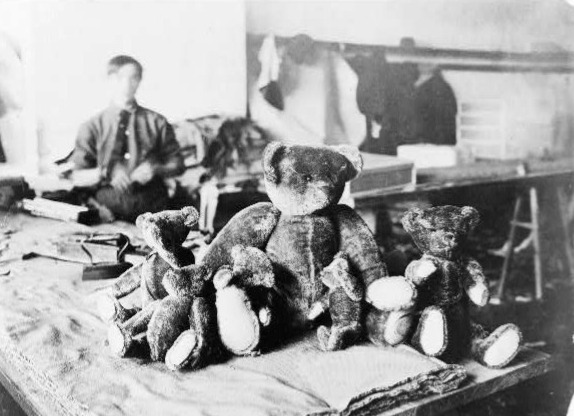
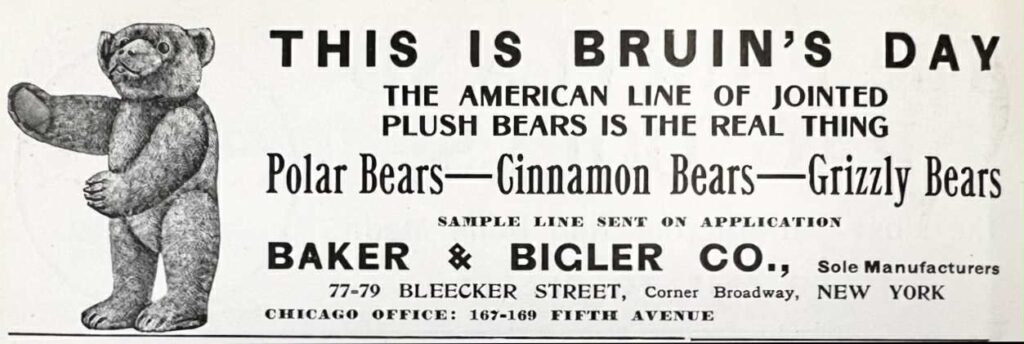
There’s no need for me to repeat the story that I’m sure we’ve all heard a thousand times before — how this furry play toy came to be known as the ‘teddy bear’. Instead, this blog will be targeted towards those who are well past that point in their collecting journey. If you do happen to be new to the hobby, a quick Google search on the origins of the teddy bear will fill you in.
Let Me Introduce Myself
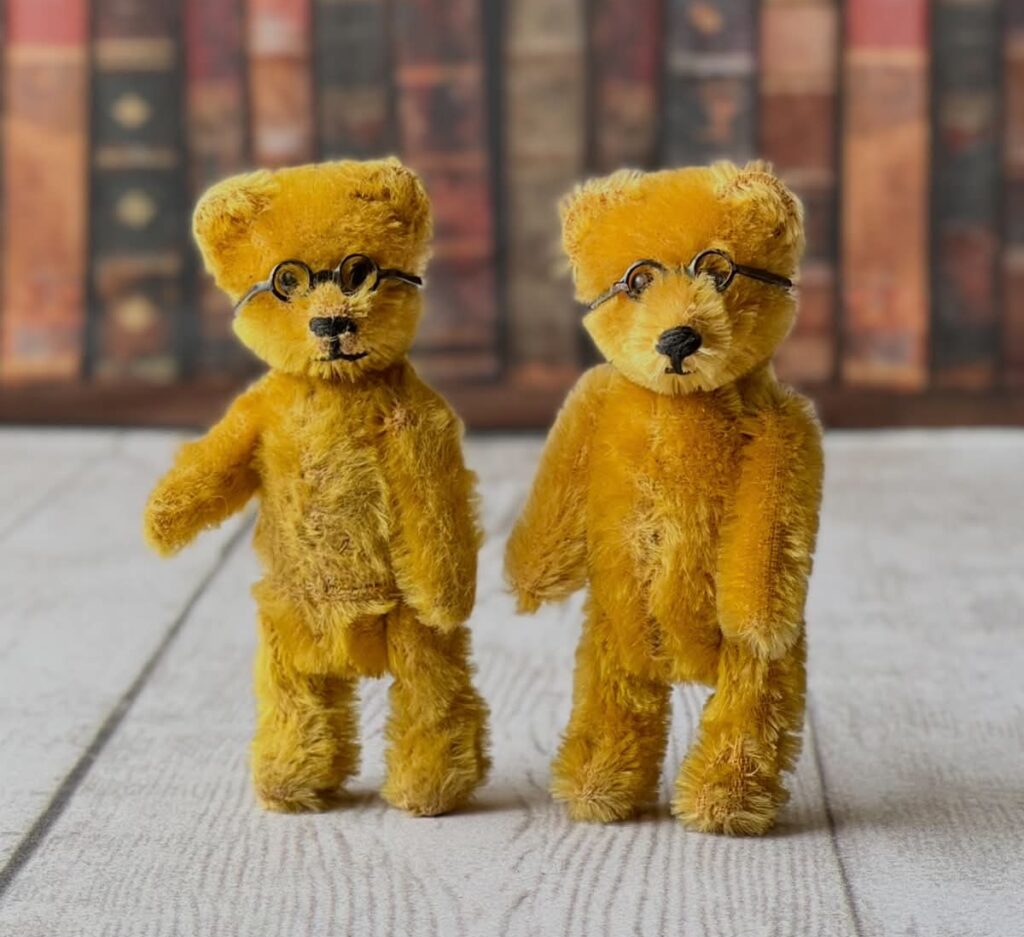
My name is Robyn, and ironically, as someone whose collection has become centred around American manufacturers, I’m a resident of Ontario, Canada. I’ve been in the business of ‘arctophilia’ since the summer of 2019. I accidentally stumbled across an early Schuco “Tricky” teddy bear on eBay during an unrelated search. Although I’d scrolled past teddies before, it was the adorable, tiny, metal eyeglasses that it was wearing which caught my attention. It was listed on auction for a starting price of $160 CAD from a local seller. I thought it was a ridiculous price to pay for a silly teddy bear, but found myself submitting a bid anyway. The auction ended with no competing offers and Simon the Schuco teddy bear came to live with me.
Going Back, Waaay Back
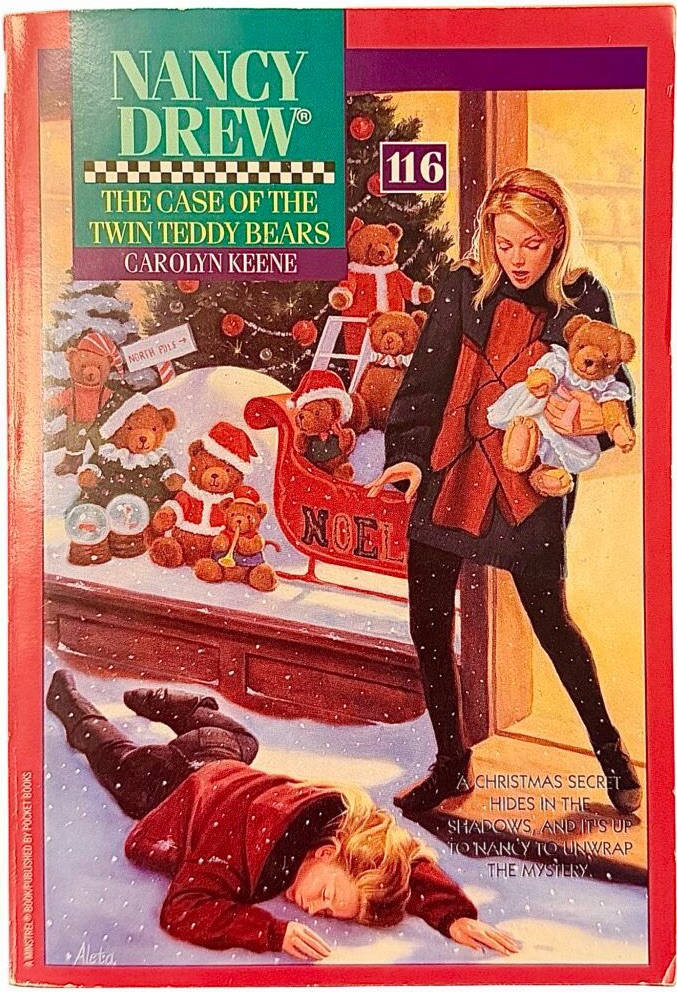
However, my love for toys and teddy bears did not start that day in 2019. I’d previously delved into artist-made bears and had a small collection started. I’ve always been a true collector by nature and swear that I could collect almost anything of any genre. As a kid, I loved reading the Nancy Drew series of books, with my favourite story being “The Case of the Twin Teddy Bears” by Carolyn Keene — a mystery which takes place in a toy and teddy bear shop called “Beary Wonderful”, where the shop owner’s prized collection of expensive antique bears was stolen. It sparked my interest at the time, and I never forgot it (I still have my original copy of the book from the 90s).
Fast-forward to adulthood — and to what had become a popular trend among millennials, I began collecting toys from my childhood. I was particularly interested in Beanie Babies and other Ty products, as the idea of them brought back so many fond memories. However, this time around, my interest was not only in collecting the items themselves, but also in researching the history of the company, while cataloguing information for products that had been lost over time. This also sparked my intrigue of vintage and antique items. I connected with a small group of friends who had similar interests, and for several years we had a blast sharing the hobby together. I learned a lot of valuable research techniques, and what we shall call “the art of competitive collecting”! While I’m no longer actively collecting TY products, our group of friends still keep in regular contact nearly a decade later, and they continue to maintain the fantastic collector website http://typlusharchive.com.
The Beginning of my Collection
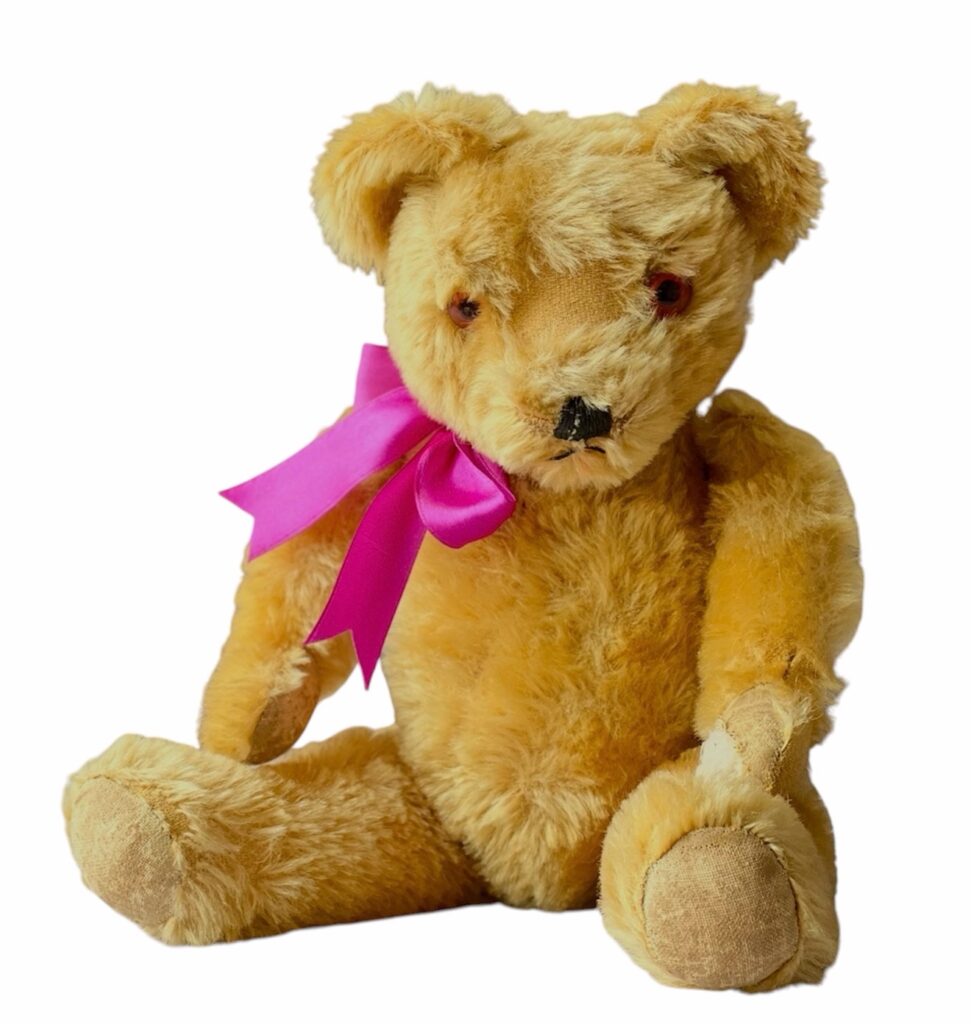
Getting back to the topic of teddy bears—while my first online purchase may have been the Schuco bear, my collection had already technically started in April of 2016, when I found my first (somewhat) antique teddy bear ‘Henry’ at the Salvation Army thrift shop, costing a mere .99 cents. At that time, I had very little knowledge of antique teddy bears, but I was able to track down information online in an attempt to ID the mystery bruin.
Following the purchase of Simon, my collection continued to grow with the addition of several more pieces from Schuco. In early 2020, I purchased a teddy bear made by the firm Weiersüller, thereafter I started to branch out to include other German manufacturers as well. One thing that I was very certain about early in my collecting was that I am not a Steiff collector. Although I have great appreciation for the founding company, with their fascinating history and beautiful teddy bear designs, I was never drawn to collect them. Instead, I found myself attracted to the smaller, lesser-known manufacturers.
Enter America
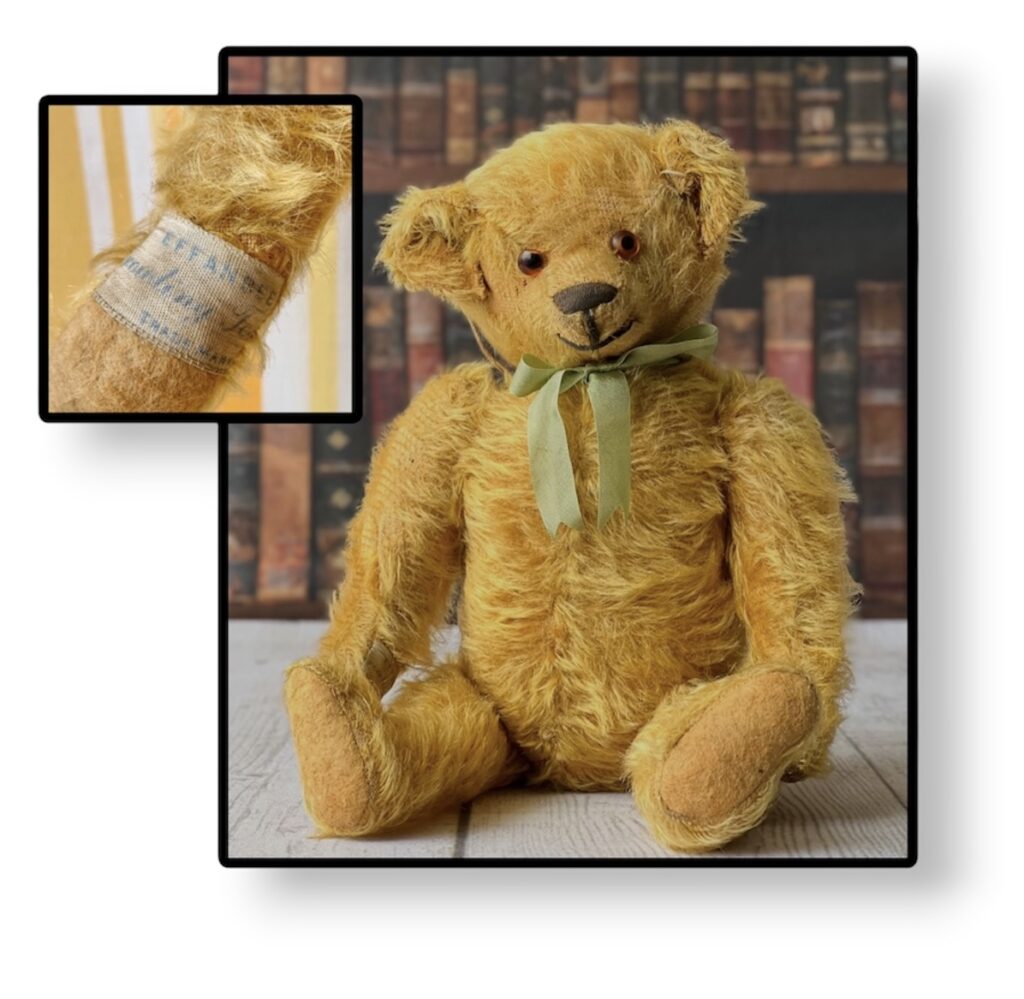
In August of 2020, I stumbled upon an unusual teddy bear on eBay that I’d never seen before. The bear had an original Effanbee “Growling Teddy” label stitched across its paw pad. It was not a company that I was familiar with, and at the time I was not able to find any information about their early production for anything other than dolls. I went back and forth on whether I should purchase the bear having so little information about it, but ultimately decided that I was too intrigued to let it go. I’m very thankful I made that decision as it was the first step into my journey into American-made teddy bears, and only one of two Effanbee bears that I’ve seen since that time. Fergus, as he came to be known, was in nearly mint condition, as though it had just plucked off the store shelf by a child in 1915.
Since then, I’ve spent hours researching the Effanbee company, and it will always be near and dear to my heart. In doing so, I also realized there was a shortage of information available in collector books about early American teddy bear manufacturers. Of those books that were available, most contained outdated information. With so few people in the hobby actively researching the subject today, I’ve felt urgency to uncover information that one day, could be lost for good.
I have great admiration for the early researchers who paved the way for the hobby, who started long before the internet. With the resources available today, we’ve been able to make great advancements piecing together the history of the American teddy bear, though we still have a long way to go. I say ‘we’ because this has been far from a solo project, and I would not have been able to come as far as I have without the help of a group of friends with similar goals. Initially, I intended to put together a reference book for collectors, as seems to be tradition in the hobby, and I think it would stand the test of time better than any website. This is still a long way off though, as the research never seems to be in any sort of a “finished” state. It is continuously being edited and added to as we learn more. For this reason, I felt that a blog would be a good place to start in the interim.
The Dreaded “I” Word
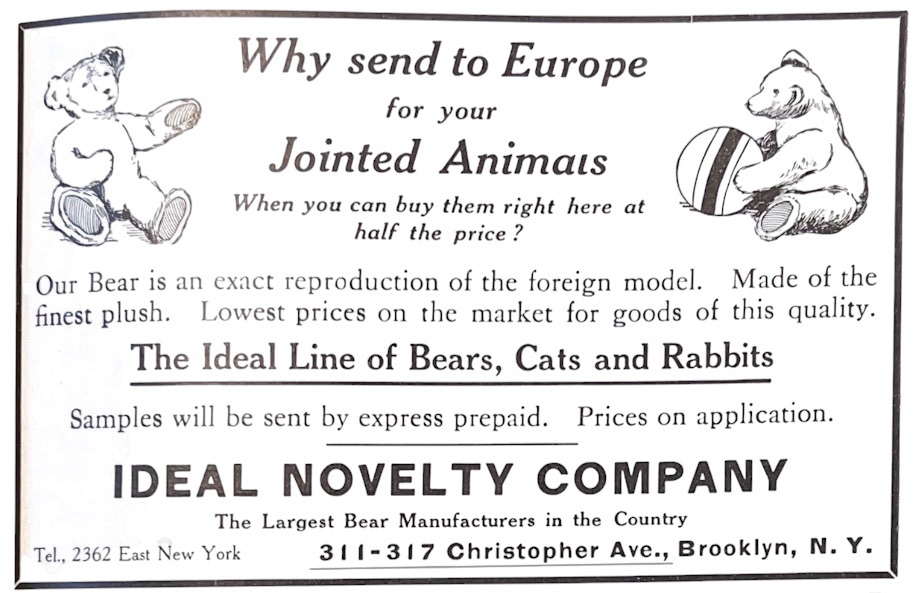
You will notice the identification of ‘Ideal’ is used sparingly around here. Too often collectors will classify bears into this category when they are stumped for a true identification. I’ve seen bears of all types, with strikingly different characteristics, being identified as ‘Ideal’. We know relatively very little about the firm’s early days, especially when compared to other manufacturers that existed in the same period, yet folks can’t seem to see past this name. Likely due to its alleged affiliation with Theodore Roosevelt. If Ideal did truly manufacture all these bears, they would have been churning out hundreds of different styles from the same factory, at the same time! I’ll leave it at that.
“Well-behaved women seldom make history” —Laurel Thatcher
Sometimes my research methods or outlandish theories don’t always align with the general opinion of the collecting community. To start, I try to stay away from making a positive identification on any bear that does not have the manufacturer’s original label — unless there is compelling evidence to support it. A poorly drawn image from an advertisement will not be enough to convince me on its own. Instead, I’ll use terms such as “likely made by” or “attributed to” — as very little of this information can be positively confirmed at this time. I try to stick to facts and evidence. On the other hand, in some posts I may present you with my own theories, hypotheses, and opinions. Staking a claim on a new idea is how researchers and scientists have solved problems since the beginning of time, as long as there is evidence to support it. I encourage you to always remain open-minded with new ideas, no matter how ridiculous you may think they are. This is, after all, how we learn.
Once the blog is up and running, my goal is to put out a post every other week. Your comments and participation are encouraged. I’m always happy to “talk teddies” with fellow collectors, and answer questions wherever I can. Thanks for stopping by Teddy Americana and happy collecting!
Leave a Reply